Often considered to be a Scandinavian version of The Go-Betweens, the intelligent, literate indie pop of Sweden’s The Wayward Souls always deserved a better fate than that summarized by their final album in 1987 ('Nobody Loves The Wayward Souls'). Between their formation in 1983 and their dissolution Hakan Fagerstedt (drums, vocals), Per Ahlen (vocals), Jonas Asp (bass, guitar, vocals) and Henrik Rosencrantz (guitar) won over critics from Europe to the USA. Their inability to convert critical acclaim into record sales always marred their career, however. Strenuous efforts were made with 'Junk Food Kings On Diet' to expand their cult audience, but the effort failed. However, the group re-formed again in 1994 to appease a loyal fanbase that had retained its affection for the band from its 80s peak. [SOURCE: ALLMUSIC]
The Very Things were one of various outfits launched under the umbrella organization of the Dada Cravats Laboratory (DcL), based in Redditch, Worcestershire, England. This group operated a number of musical projects under Dada principles: ‘Using that banner was a lot simpler than delivering lengthy manifestos’. The key personnel involved were The Shend (b. Chris Harz; vocals) and Robin R. Dallaway (aka Robin Raymond; guitar), plus Gordon ‘DisneyTime’ (drums), and Fudger O’Mad aka Budge (ex-And Also The Trees; bass). Other groups operating out of the same stable included The Cravats, Babymen, and DcL Locomotive. Their first single, ‘The Gong Man’, explored responsibility and the work ethic. Although they were coming from a less strident political standpoint, they found allies in anarcho-punk band Crass, with this being the second of two singles coming out on their label (the previous one under The Cravats logo being ‘Rub Me Out’). On the back of this, and a very successful radio session for BBC disc jockey John Peel, they were signed to Reflex Records for the release of 'The Bushes Scream While My Daddy Prunes'. An early appearance on television music programme The Tube helped bolster their fortunes, while the follow-up single, ‘Mummy You’re A Wreck’, was an equally entertaining offbeat production. After a series of personnel changes, they folded in 1988, leaving behind the Motown-influenced 'Motortown' (produced by Ray Shulman, ex-Gentle Giant, and Derek Birkett, ex-Flux Of Pink Indians). The Shend turned to acting, appearing in television series such as The Bill and EastEnders, playing, somewhat predictably, intimidating characters. The two ‘Robs’ departed to form their own band under the title Hit The Roof. [SOURCE: ALLMUSIC]
More expressly political than their German counterparts Einstürzende Neubauten, Test Department followed the same tack: a creative use of the ethos in which diverse objects (including large amounts of scrap metal and power tools) can be used as instruments. Formed in London's New Cross in 1982 by Alistair Adams, Graham Cunningham, Tony Cudlip, Gus Ferguson and Paul Jamrozy, the quintet became renowned for the staging of huge multimedia events at obscure venues -a railway works in Glasgow, a sand quarry, Cannon Street Station in London, a Welsh car factory- and their political agenda, which has included action against apartheid, the rise of neo-Nazism and Britain's Criminal Justice Act. The quintet signed to Some Bizarre Records for 1984's 'Beating the Retreat', and outlined their socialist agenda set to music on the following year's 'Shoulder to Shoulder', recorded with "the South Wales Striking Miners' Choir." After forming their own Ministry of Power label to organize multimedia events, Test Department released two records -'The Unacceptable Face of Freedom' and 'A Good Night Out'- in a MOP/Some Bizarre conjunction, but struck out on their own with 1988's 'Terra Firma'. Test Dept.'s sixth album, 'The Gododdin', was followed by their most scathing criticism of British politics, 'Pax Britannica', in conjunction with the Scottish Chamber Orchestra and Choir. After releasing albums for Jungle Records and Dossier, the group gained a contract with the American industrial label Cleopatra in 1994 and released the fruit of their early-'90s work on 'Legacy (1990-1993)'. Signed to Cleopatra's subsidiary Invisible, Test Dept. released the new albums 'Totality' (1995) and 'Tactics for Revolution' (1998), as well as reissuing several previous works. [SOURCE: ALLMUSIC]
Scritti Politti is the primary vehicle for Welsh singer/songwriter Green Gartside. Few figures in pop music can claim Gartside's distinctive credentials: an artist who began in London's subcutaneous underground in the late '70s but ultimately rose to the top of the U.K. pop charts, a serious devotee of linguistic structuralism who can hold his own in a conversation with his friend, arch deconstructionist Jacques Derrida, and a handsome, dreamy-eyed gentleman who has, in the opinion of one critic, "a voice that's eternally 14 years old" yet nonetheless stands six foot six in his stocking feet.
Gartside grew up in South Wales, a brainy underachiever and, in his teen years, a member of the Young Communist League. Through the League he met future Scritti Politti bassist Nial Jinks. Gartside earned a scholarship to Leeds Art College, where he made the acquaintance of Scritti's future drummer, Tom Morley. In June 1978 Gartside and Morley dropped out of school and took up a flat in London, and Gartside invited Jinks to come out and join them. Inspired by the example of another little-known English group of that time, Desperate Bicycles, Scritti Politti made their first record when they were barely three months old, hand printing the covers and rubber-stamping the labels themselves. This record, 'Skank Bloc Bologna', sold a surprising 2,500 copies in this handmade edition. Afterward, Rough Trade took it over, ultimately moving about 15,000 copies of the title. Although listed as a member of the group on records and in photographs, Matthew Kay was the band's business manager and had little to contribute to Scritti Politti's music.
At this stage, Scritti Politti's sound was scrappy, taut, and forthrightly experimental in style, utilizing abrupt changes, rhythmic displacements, and gritty and discordant harmonies tempered by Gartside's sweet vocalizing of impenetrably obscure lyrics, vaguely political in sense but temporal and abstract in meaning. Yet there was something catchy about what they were doing that stuck with the listener, and Rough Trade in particular was very excited about it. In quick succession, Rough Trade released the 12" EP '4 A-Sides' (also known as 'Pre-Langue EP') and a four-track single of Scritti Politti's second Peel Session. The band was then added to a U.K. tour featuring Gang of Four and Joy Division, but Gartside was consumed by stage fright and anxiety, leading to his first heart attack at age 23. After completing the tour, Gartside decided to take a year off from music and returned to South Wales to refresh himself.
When Gartside returned, it was a with a new Scritti Politti sound, now centered in pop but still retaining the obscure lyrical elements. A demo track, "The Sweetest Girl," was issued on a giveaway cassette in conjunction with an issue of NME, and it soon proved extremely popular in England. While the finished single of "The Sweetest Girl" did not appear for several months, sapping some of the momentum gained by the pre-release, the follow-up album, 'Songs to Remember', was issued to considerable critical acclaim in September 1981. The album made it to number one on the U.K. independent album chart and number six on the main U.K. pop chart. By this time, however, the band had fallen apart, and the last original member, drummer Tom Morley, departed that November. Gartside once again took time out to review his position, and in the meantime a bidding war began among major labels for his talents.
Gartside had spent some time in New York on holiday during the making of 'Songs to Remember' and had met another aspiring Rough Trade songwriter, David Gamson, who in turn introduced him to the drummer from Material, Fred Maher. They began to record as Scritti Politti in 1983 in sessions produced by Nile Rodgers, but Gartside decided, rightly, that Rough Trade didn't have the kind of budget that could support the type of pop music that he was then interested in pursuing. With Gartside and Rough Trade parting ways, the Rodgers-produced sessions never saw the light of day. After negotiating with various labels, including Atlantic Records, Gartside finally settled on an offer made by Virgin. Then he, Gamson, and Maher began slowly recording the group of singles that ultimately made up 'Cupid & Psyche 85'.
'Cupid & Psyche 85', released in June of 1985, was a landmark album in many respects. No prior pop album had integrated the techniques of sampling and sequencing to such a great degree, and the technology of that time was both expensive to use and barely up to the task Scritti Politti demanded of it. Gartside's typically high-flown verbiage was as evident here as anywhere, but you didn't need to understand what he sang in order to enjoy the music. Certain songs are dialogues between Gartside and a female singer; as such, "A Little Knowledge" is a rare pop song that retains the characteristics of a mini-tragedy. Likewise, the bonus track of "Flesh and Blood," featuring Jamaican rapper Ann Swinton, sounds remarkably fresh and contemporary 20 years on. But the big hits from 'Cupid & Psyche 85' were "Wood Beez" and "The Word Girl" in the U.K., and "The Perfect Way" in the U.S., which reached number 11 in the Billboard Hot 100 and got heavy rotation on MTV. Not many albums from smack in the middle of the "Big '80s" can be said to possess the quality of timelessness, but 'Cupid & Psyche 85' most certainly does.
The innovative aspects of 'Cupid & Psyche 85' were not lost on other musicians, who absorbed the technological lessons therein so quickly that few, if any, critics stopped to take note of where these ideas originally came from. After touring and promoting 'Cupid & Psyche 85', Gartside took some time off to work with other artists, notably Chaka Khan. Scritti Politti returned in 1988 with a new album, 'Provision', of which the intended hit, "Boom! There She Was," featured the talents of the late Roger Troutman. 'Provision' found favor in the U.K., but had no effect whatsoever in the U.S., and worse, Gartside was personally unhappy with the album. By this time Gartside's stage fright had caused him to abandon live performance altogether, and the only promotional outlet for him was to do a grueling round of local talk shows answering dumb questions from interviewers who hadn't the slightest clue about Gartside or his work. Disgusted with music as a whole, Gartside dropped from sight again, and this time he did so for nearly a decade.
Released in 1999, 'Anomie & Bonhomie' marked Gartside and Scritti Politti's return to music, and it shows that he had by no means lost touch with current trends, working with rappers Mos Def and Jimahl and extending the Scritti Politti compass to include a full-blown hip-hop sound. It was a fine comeback effort, but received only a lukewarm response from the public. 'White Bread Black Beer', recorded entirely by Gartside, followed seven years later and had the benefit of closely tailing a wave of newfound interest in his career. (Rough Trade had released the 'Early' compilation in 2005.) One can only hope that Gartside can keep at it, as while bands may come and bands may go, there is only one Green Gartside, a popular artist of rare integrity, poetry, and intelligence. [SOURCE: ALLMUSIC]
One of England's more subtly original goth rock groups, Red Lorry Yellow Lorry were initially branded as worshipful Joy Division acolytes, but came up with enough distinct variations to break free of their main influence. Their foundation always remained icy, droning post-punk, replete with sludgy, murky guitars and mumbled Ian Curtis-style vocals. However, as the Lorries evolved, they gradually sprinkled in elements of industrial dance, early rave music, and spaghetti Western soundtracks, as well as liberal doses of inventive, acid-tinged guitar work. Taking their name from a British tongue twister, Red Lorry Yellow Lorry were formed in Leeds in late 1981 by guitarist/songwriter Chris Reed and vocalist Mark Sweeney. Reed and Sweeney had previously performed in the local bands Radio Id and Knife Edge, respectively, and added a rhythm section of bassist Steve Smith and drummer Mick Brown. Sweeney left within a year, however, and Reed took over lead vocal duties, with Martin Fagan coming onboard as a second guitarist.
Later in 1982, Red Lorry Yellow Lorry signed with the independent Red Rhino label and issued their debut single, "Beating My Head." Although it was a hit on the British indie charts, Fagan subsequently left the band and was replaced by Dave "Wolfie" Wolfenden, who became Reed's frequent songwriting partner; bassist Smith also departed in favor of Paul Southern. The band's second single, "Take It All," appeared in 1983, as did the third, "He's Read"; both helped solidify the Lorries' popularity on the indie listings. After another single, 1984's "Monkeys on Juice," the band finally got around to recording its debut album; 'Talk About the Weather' was released in early 1985, and was a hit on the indie charts thanks to the single "Hollow Eyes." It was followed by two non-LP singles, "Chance" and "Spinning Round."
In 1986, Reed and Wolfenden regrouped with a new rhythm section of bassist Leon Phillips and drummer Chris Oldroyd. They were in place for the Lorries' second LP, 'Paint Your Wagon', which drew on imagery of the old American West and featured another indie hit in "Walking on Your Hands." Following one more non-LP single that year, "Cut Down," the band temporarily adopted its longtime nickname of The Lorries, and issued one single, 1987's "Crawling Mantra," under that moniker before reverting back to the original form. Later in 1987, Red Lorry Yellow Lorry signed a major-label deal with Situation Two, a subsidiary of RCA affiliate Beggars Banquet. They debuted in 1988 with the LP 'Nothing Wrong', which spun off the single "Only Dreaming (Wide Awake)."
On their second major-label album, 1989's 'Blow', the Lorries flirted with the sound and visual style of England's emerging rave culture, resulting in their clearest, most spacious production to date. There was more turnover in the rhythm section; drummer Oldroyd was replaced by Mark Chillington prior to the recording of the album, and bassist Phillips departed before the supporting tour, with his spot permanently filled by Gary Weight. Chillington, in turn, left during the tour, and George Schulz came onboard in his stead. The Lorries subsequently parted ways with Beggars Banquet and released their fifth LP, 'Blasting Off' -with several songwriting contributions from Weight- in 1991, on the small Sparkhead label. The album didn't appear in the U.S. for another three years, until Relapse finally picked it up. By that time, faced with diminishing returns, Red Lorry Yellow Lorry had disbanded. Several CD retrospectives of the group's work have since been released, including the career-spanning 2014 box set 'See the Fire'. Reed revived the Red Lorry Yellow Lorry name in 2004 with four new tracks made available on the band's website, but a promised album never appeared. [SOURCE: ALLMUSIC]
Having tested the water as Orange Disaster, then The Architects Of Disaster, these calamitously inclined types finally settled on The Perfect Disaster in 1984, as the original rhythm section departed to form Fields Of The Nephilim. The initial UK-based line-up comprised Phil Parfitt (guitar/vocals), Allison Pates (guitar), John Saltwell (bass) and Malcolm Catto (drums), although personnel changes were to plague the band’s career. Ignored by the British music scene, The Perfect Disaster took their twisted, broody guitar sound to France for their self-titled debut album in 1985. There followed a couple of years of blank struggle on both sides of the English Channel before the band signed to Fire Records at home and released the critically acclaimed 'Asylum Road'. Prior to this, Saltwell and Pates both left, disillusioned, to be replaced by bass player Josephine Wiggs and guitarist Dan Cross.
In 1989 better prospects lurked over the horizon: the 'Up' album, which stretched splendidly from fiery two-chord blasts to near-suicidal ramblings, coincided with prestigious live shows with the likes of The Jesus And Mary Chain. The band’s initial inspiration, based upon singer Parfitt’s spell working at a Victorian mental institution, looked set to reap rewards. The public, alas, did not share the critics’ enthusiasm for the band. The 1990 release 'Heaven Scent', for which Jon Mattock was borrowed from Spacemen 3 to play drums, continued The Perfect Disaster’s foray into the darker side of alternative music. Rumours of the band’s demise, which persisted throughout 1991, were finally confirmed. Wiggs had left during the recording of 'Heaven Scent' to spend more time on the Breeders, a project that also involved Tanya Donelly from Throwing Muses and Kim Deal of Pixies, allowing John Saltwell to return on bass. Parfitt went on to write alongside Jason Pierce (Spiritualized) and work with the short-lived Psychotropic Vibration, before forming Oedipussy. [SOURCE: ALLMUSIC]
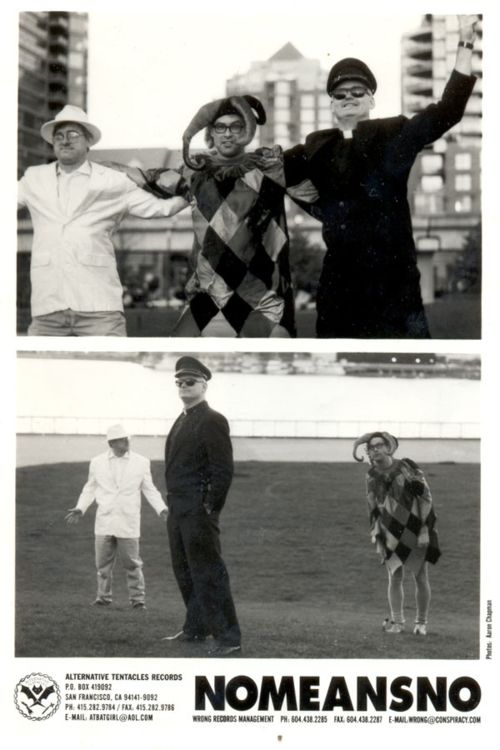
An often bizarre punk band from Victoria, British Columbia, Nomeansno formed around brothers Rob (bass, guitar, vocals) and John Wright (vocals, drums, keyboards). Andy Kerr joined up in the early '80s on guitar and vocals, and upon his departure in the early '90s, the band recruited guitarist Tom Holliston as his replacement. The group's punk hybrid also encompasses touches of jazz, funk, and metal, with special emphasis laid on jarring, hard-to-follow rhythms. Their lyrics are often self-consciously weird, but Nomeansno are frequently original and challenging. With countless releases over the years (tenth full-length 'All Roads Lead to Ausfahrt' appeared in 2006), the band has issued music through labels like Alternative Tentacles, AntAcidAudio, Southern, and their own, Wrong Records. The Wright brothers also spent time playing with their side band The Hanson Brothers, basically a ridiculous Ramones tribute band they did with some buddies. [SOURCE: ALLMUSIC]
The British band McCarthy is probably remembered more for their left-wing politics than their jangly sound. Formed in Barking, Essex, England, in 1985, McCarthy consisted of Malcolm Eden (vocals, guitar), Tim Gane (guitar), John Williamson (bass), and Gary Baker (drums). Gane was originally a drummer, but Eden taught him how to play a number of chords on a guitar. Both musicians were influenced by British punk groups such as the Sex Pistols, The Clash, and the Buzzcocks, and they covered their songs in small gigs. By the time Eden completed his studies at a university, his Marxist beliefs had grown deeper, reflected in his lyrics for McCarthy. In 1987, McCarthy released their debut LP 'I Am a Wallet'. The album was virtually ignored by U.K. radio programmers, except for legendary British DJ John Peel. Because of Eden's political views, the band was often lumped in with less pop-oriented acts like Billy Bragg and The Redskins, comparisons that upset the group. The band's second album, 'The Enraged Will Inherit the Earth', appeared in 1989. However, after the group recorded their third full-length, 1990's 'Banking, Violence and the Inner Life Today', Eden felt there was no need to continue; he believed that McCarthy's creativity peaked with that LP. Moreover, he was burned out from touring. Consequently, the group split up and Gane formed Stereolab with his girlfriend Laetitia Sadier, who also sang on McCarthy's last album. Eden released material with Herzfeld. [SOURCE: ALLMUSIC]
With no "proper" musical skills upon their formation in Surrey, England, the Lemon Kittens epitomized the "anything goes" spirit of late-'70s post-punk in the U.K. Karl Blake, who cut his teeth in numerous outfits prior to the Lemon Kittens, started the band with Gary Thatcher and a revolving cast of others (which at one point included future Alternative TV leader Mark Perry), but at the time of the release of their first EP in 1979, the seven-song 'Spoonfed + Writhing' 7", the group's lineup featured Blake, Thatcher, N. Mercer, Mylmus, and Danielle Dax. The group was whittled down to a duo of Blake and Dax by February of 1980; the other three members had fled, making for the group's 16th different lineup change since initialization in April 1978. Blake and Dax then decided to operate primarily as a duo, with help coming from whoever whenever they needed the assistance to perform. Later in 1980, Blake and Dax released 'We Buy a Hammer for Daddy' on the United Dairies label (their labelmates included fellow oddballs and noise-mongers Whitehouse and Nurse With Wound), an album that featured the duo swapping a wide variety of instruments. 'The Cake Beast' EP came out in February of 1981; Dax left after its release to begin a successful solo career, which Blake took part in sporadically throughout the '90s. In late 1982, the Illuminated LP 'Those That Bite the Hand That Feeds Them Must Sooner or Later Meet...the Big Dentist' (best referred to as 'The Big Dentist') became the group's second full-length. Blake rounded up a new group of cronies, laid the Lemon Kittens to rest, and began the Shock Headed Peters. [SOURCE: ALLMUSIC]
During the punk rock era of the late '70s, there were three bands comprised of women who made some of the best, most adventurous, exhilarating, and most critically derided music of the time. Two were the English bands The Slits and The Raincoats, and the third band, from Switzerland, was Liliput. Fans of all three bands will argue ad infinitum as to who was the better. But one thing is for certain: Liliput was an amazing band that recorded amazing music, and comparing what they accomplished to that of another band is a useless intellectual exercise. Besides, it detracts from valuable listening time.
Formed in Zurich in 1978 by guitarist Marlene Marder and bassist/vocalist Klaudia Schiff, they began with the name Kleenex until the threat of a lawsuit by corporate giant Kimberly-Clark (who had copyrighted the name Kleenex) forced them to become Liliput in 1980. Recording for the great English indie label Rough Trade, the then-Kleenex produced jumpy, aggressive, clamorous punk-noise that featured Marder's scratchy, semi-melodic guitar and Schiff's yelping vocals. Not punk rock in the fast, loud, economical sense, Liliput were forging a different kind of punk, one that was gleefully anarchic, avant-garde, unrestrained, and suffused with a giddy, almost palpable sense of joy. Listening to this music, one gets the sense that there was a near-rapturous enjoyment that went into these recordings. Their tenure at Rough Trade was short, as was their interest in exploring career options beyond Europe.
By 1982, when they released their first LP, they seemed perfectly happy remaining in Switzerland, running the band as part of numerous other artistic projects (painting, writing, etc.) they pursued. By the end of 1983, Liliput had disbanded, and the music they had recorded quickly achieved legendary, but mostly unheard, status. As for the band, they seemed destined to be relegated to the status of feminist-inspired punk rock footnote. All of this changed in 1993, when the Swiss label Off Course released a double-disc, 46-track compilation of the entire recorded output of Kleenex/Liliput. The result was one of the great reissues of the decade. Unfortunately, it went out of print shortly after its release, but Kill Rock Stars released it again in early 2001, making it more accessible than before. The exuberance and excitement of Liliput's breathtaking music can be enjoyed once again, and a band that was almost forgotten returns with some of the most artful, contemporary, truly alternative music to be recorded under the genre identifier of punk rock. Also, fans of riot grrrl rock take note: this was a tremendously influential band. Although they eschewed extreme confrontation, there is a compelling sense of self that imbues this music and lit the way for a new generation of female musicians. [SOURCE: ALLMUSIC]