Enigmatic, moody, and challenging, Britain's Wolfgang Press were one of the most mercurial talents of the post-punk era, restlessly moving from gothic noise to dark balladry to eccentric funk; paradoxically, the group was also the 4AD label's longest tenured artist -even their stylish album packages were all the product of the same designer, Alberto Ricci.
Formed in London in 1983, The Wolfgang Press comprised vocalist Michael Allen, guitarist Andrew Gray, and keyboardist Mark Cox. Allen and Cox first teamed in the group Rema Rema, which also featured Adam & the Ants alum Marco Perroni; after reuniting in the short-lived quartet Mass, the duo recruited Gray, and as The Wolfgang Press issued their cacophonous, gloomy debut LP, 'The Burden of Mules', in 1983. An EP trilogy co-produced by Cocteau Twin Robin Guthrie followed in quick succession: while 1984's 'Scarecrow' was a lighter, more streamlined affair, 1985's 'Water' spotlighted ominously sparse torch songs, and the same year's 'Sweatbox' explored deconstructionist pop.
The Wolfgang Press' second full-length effort, 1986's 'Standing Up Straight', incorporated industrial and orchestral influences into the mix, while the 'Big Sex' EP's "God's Number" offered a soulful backing chorus, a harbinger of things to come. Indeed, after 1988's hypnotic 'Bird Wood Cage' and its leadoff single, "King of Soul," introduced strong elements of dub, reggae, and R&B, the trio took the full plunge into the dance arena with 1991's 'Queer', an idiosyncratic outing admittedly inspired by De La Soul's landmark "3 Feet High and Rising"; the first single, a surreal cover of the Randy Newman-penned "Mama Told Me Not to Come," was a minor hit. 1995's 'Funky Little Demons' completed The Wolfgang Press' transition into white funk; prior to its release, however, Cox exited the group's ranks. [SOURCE: ALLMUSIC]
A side group started in 1982 by Mekons co-founder Jon Langford, The Three Johns, originally made up of Langford, John Hyatt, Phillip "John" Brennan, and a drum machine, specialized in abrasive, politically charged, danceable rock. Sounding almost nothing like Langford's main band, the Johns were a silly-serious bunch of political and cultural provocateurs. Recording during the height of Margaret Thatcher's ill-conceived Tory rebellion, the Johns were openly antagonistic to this new, conservative vision of Britain's future. And while their elliptical and epigrammatic lyrics might not offer the sloganeering that would easily identify them as lefties, certainly there were enough hints dropped along the way to remove any doubt. Unlike other rock agit-prop, the Johns played a fairly accessible version of polemical post-punk anti-pop that embraced big, messy arena-rock-sounding guitars and hard, repetitive, quasi-hip-hop dance beats. Perhaps the most subversive thing about the Johns is that, despite Langford's and Hyatt's goofy vocals, they were, in their own weird way, pure pop for now people, especially those who hated Thatcher. With collective tongue planted firmly in cheek, the Johns took on British and American obsession with materialism, the diabolical Reagan-Thatcher lovefest, the machinations of the pop music industry, all of it done with a great sense of humor mixed in with genuine fear and horror. Frequently hard to pin down, the Johns reveled in being slippery, exhibiting a love and loathing for pop music. In some respects, the Johns resembled friends and fellow Leeds, England mates the Gang of Four, but where the Gang of Four was dour and serious (bordering on academic), the Johns were loutish and boisterous, which when combining politics and rock & roll can, ultimately, be a good thing. After the release of 'Eat Your Sons' in 1990, Jon Langford turned his attention full-time to the Mekons, putting The Three Johns on what has turned out to be an indefinite sabbatical. [SOURCE: ALLMUSIC]
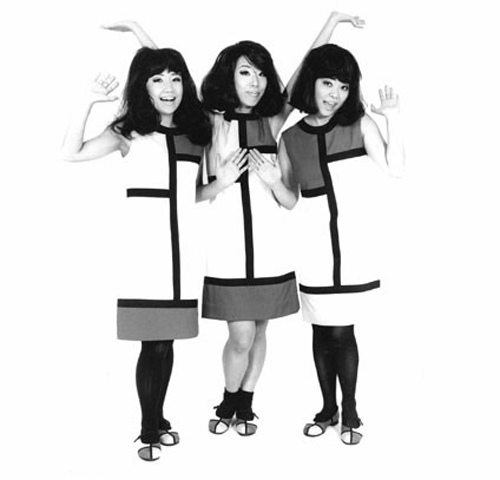
The Japanese trio Shonen Knife have made major fans out of alt-rock's elite (Sonic Youth, Nirvana, and Redd Kross, among others) and built a solid, worldwide cult following with their Ramones meets The Beatles brand of sticky sweet punk-pop. Comprising members Michie Nakatani (vocals, bass), Naoko Yamano (vocals, guitar), and Atsuko Yamano (drums), Shonen Knife originally formed during December of 1981 in their hometown of Osaka, Japan (all three members were working at the time as office clerks), before playing their first real show in March of the following year. Soon after, the group began issuing albums in its native land, including 1982's cassette-only release 'Minna Tanoshiku' (English translation: 'Everybody Happy?'), 1983's 'Burning Farm', 1984's 'Yama No Attchan', and 1986's 'Pretty Little Baka Guy' (the latter of which was reissued with extra tracks four years later, under the title 'Pretty Little Baka Guy/Live in Japan'). Although their records were only available in the U.S. via import, Shonen Knife struck a chord with the underground with a track that appeared on the "Sub Pop 100" compilation in 1986. Also, in 1989, a variety of alternative bands recorded renditions of their favorite Shonen Knife songs for the tribute album "Every Band Has a Shonen Knife Who Loves Them".
The first Shonen Knife release to be issued outside of Japan, a 1990 self-titled compilation featured the entire 'Burning Farm' and 'Yama No Attchan' albums, as well as three tracks that were only previously available on the obscure Japanese comp Aura Music. Shortly thereafter, the group began touring America on a somewhat regular basis, supporting their 1991 release '712' with some dates opening for Nirvana just prior to the runaway success of Cobain and company's now-classic "Nevermind" album. Now the hip band to name-drop, Shonen Knife signed their first major U.S. recording contract with Capitol, resulting in the release of one of their finest (and best-known) albums, 1992's 'Let's Knife'. A year later, the group switched to the Virgin label, issuing 'Rock Animals', which would spawn a semi-popular MTV video with "Tomato Head" (even landing a spot on the station's popular animated series "Beavis & Butthead").
In 1994 the trio performed as part of the traveling alternative rock festival Lollapalooza and contributed a cover of "Top of the World" to The Carpenters tribute album "If I Were a Carpenter", while Virgin issued an 18-track collection of rare tracks, 'Birds & the B-Sides', in 1996. Although they were able to greatly expand their U.S. fan base, Shonen Knife never obtained the breakthrough success that was expected by many, resulting in the group returning to the independents and issuing such further releases as 1997's 'Brand New Knife', 1998's 'Happy Hour', and the 2000 Japan-only release 'Strawberry Sound' (which featured the band's revamped lineup of Atsuko Yamano on bass and Mana Nishiura, who joined Shonen Knife after Nakatani left in 1999, on drums).
Vocalist Naoko Yamano was the only original member for the mid- to late 2000s, but even after 20-plus years, and difficulties maintaining a consistent lineup, the band showed no signs of slowing. In 2005, Oglio reissued the band's first four albums, and the band released 'Genki Shock' in Japan; late that year, Nishiura was killed in a New Jersey traffic accident while touring with DMBQ. Both Shonen Knife and DMBQ performed at a tribute concert for Nishiura that was held in Kyoto in spring 2006, shortly before the U.S. release of 'Genki Shock'. Shonen Knife continued on with drummer Etsuko Nakanishi and bassist Ritsuko Taneda, releasing a live album and another full-length titled 'Super Group' in 2009. A few months after completing 2010's 'Free Time', drummer Nakanishi parted ways with the band, to be replaced by Emi Morimoto; the Yamano/Taneda/Morimoto lineup released 'Pop Tune' in 2012 and 'Overdrive' in 2014. [SOURCE: ALLMUSIC]
Nihilistic Portland, Oregon hardcore outfit Poison Idea was formed in 1980 by frontman Jerry A., guitarist Tom Roberts, bassist Chris Tense, and drummer Dean Johnson. The group debuted three years later with the EP 'Pick Your King', cramming 13 songs into a 16-minute time frame; the 'Record Collectors Are Pretentious Assholes' EP followed in 1985, fine-tuning the band's blistering sound and fatalistic worldview. Thanks to their notoriously insatiable diet of drugs, alcohol, and junk food, the members of Poison Idea all ballooned past the 300-pound mark by the time of their 1986 full-length 'Kings of Punk', with Roberts -who then tipped the scales at an impressive 450 pounds- rechristening himself Pig Champion in honor of the occasion. Tense and Johnson were then dismissed from the lineup, although the former returned in time for 1987's 'War All the Time', recorded with second guitarist Eric "Vegetable" Olsen and drummer Steve "Thee Slayer Hippy" Hanford; Tense was then replaced by bassist Mondo for 1988's 'Filthkick' EP. Both the 'Darby Crash Rides Again' and 'Ian MacKaye' EPs followed a year later, along with another period of roster tumult, which made way for the addition of guitarist Kid Cocksman (soon to be replaced by Aldine Striknine) and bassist Myrtle Tickner. Poison Idea returned in 1990 with 'Feel the Darkness', with a series of live releases (the 'Official Bootleg' EP, the 'Live in Vienna' EP, and the 'Dutch Courage' LP) preceding 1992's 'Blank Blackout Vacant'. A collaboration with Jeff Dahl appeared a year later, concurrent with the covers album 'Pajama Party'; however, in the wake of Pig Champion's subsequent departure, Poison Idea disbanded, releasing their June 6, 1993 farewell gig at Portland's La Luna as 'Pig's Last Stand'. The breakup was short-lived, however, and they were back at it by the end of 1999, with Jerry A. and Pig Champion joined by guitarist Matt Brainard, bassist Chris Carey, and drummer Chris Cuthbert. Guitarist Jimmy Taylor replaced Brainard for a European tour in 2003, but ended up staying on as a permanent addition for further touring, as well as the 2005 recording of material that would become their next album, 'Latest Will and Testament'. In January of 2006, Pig Champion passed away at age 47 of undetermined causes. 'Latest Will and Testament' saw release that May, though the band didn't play live again for over a year. They played and recorded intermittently in the time following Pig's death, with more multiple lineup changes and only a little bit of new music seeing release, usually in the form of split 7" singles. On a five-week tour of Europe in 2012, Jerry A. developed a foot infection that medical professionals advised was serious enough to merit the band canceling the tour completely. A. declined, suffering through the infection and completing the tour, with the consequence of having two toes amputated when he finally returned home. In late 2013, the band announced yet another lineup change, with Natalie Lucio joining up as bassist -the first-ever female member of the band. Eric "Vegetable" Olsen returned to the fold around this time as well, ending nearly 25 years of absence since the last time he'd played with Poison Idea. The next few years brought even more touring, with the announcement of new record 'Confuse and Conquer' slated for release on Southern Lord in spring of 2015. [SOURCE: ALLMUSIC]
When his punk band, The Pop Rivets, broke up in 1980, Billy Childish formed a new group with Mickey Hampshire, a Pop Rivets roadie who had been performing in a group called Mickey and the Milkshakes. The two began writing songs together and released their first LP, 'Talkin’ About', in 1981. With Childish on guitar and vocals, Hampshire on guitar and vocals, Bruce Brand on drums, and Russ Wilkins (later replaced by John Agnew) on bass, Thee Milkshakes sound was a primitive blend of British beat groups, like the early Kinks at their toughest, and hard-rocking American guitar instrumentalists, like Link Wray. This sound came to be known as the “Medway sound” and Childish has been playing a variation on it throughout his whole career. Thee Milkshakes were a very prolific group, recording nine records in their six years together. Childish and Hampshire split the lead vocal duties and the band was very much a blend of Childish’s primitive songwriting and Hampshire’s more melodic leanings. The group also masterminded and backed a Medway girl group, The Delmonas. Thee Milkshakes broke up in 1984 and Childish, Brand, and Agnew went on to form Thee Mighty Caesars where Childish’s raw punk-blues could roam untainted by any semblance of professionalism. [SOURCE: DAMAGED GOODS]
Ludus are one of the less-known Manchester bands of the post-punk era. Formed in 1978 by former Manicured Noise guitarist Arthur Kadmon, the group initially consisted of former Nosebleeds drummer Philip Tolman, bassist Willie Trotter, and vocalist Linder (Linda Mulvey), a Manchester scenester who designed record sleeves and posters for Buzzcocks and Magazine. She also became a close friend of Morrissey, who was significantly inspired by her. Ludus debuted on Richard Boon's New Hormones label in 1980 with 'The Visit', a 12" single. Another single, 'My Cherry Is in Sherry', followed months later. By the time of 1981's five-song 'Pickpocket' cassette, the band's membership changed to Linder, guitarist/bassist Ian Devine, and drummer Graham Dids. The cassette was followed with the 'Mother's Hour' single and the debut LP 'The Seduction'. 'Danger Came Smiling', the band's sophomore LP, appeared in August of 1982. The confrontational Linder, who wasn't foreign to taking the stage donning a dildo and slices of meat (her menstrual egg timer was given a catalog number by Manchester's infamous Factory label), eventually became less involved with music to be further involved with the visual arts. [SOURCE: ALLMUSIC]
Fusing hard rock muscle with the high-decibel rebellion of Detroit rock trailblazers such as MC5 and The Stooges, Thee Hypnotics' maximum-impact approach came along just as the likeminded grunge explosion was starting to take off, and while the band never quite broke through in the United States, it won its fair share of press and popularity at home in the United Kingdom. Comprised of vocalist James Jones, guitarist Ray Hanson, bassist Will Pepper, and drummer Mark Thompson, Thee Hypnotics came together in their hometown of High Wycombe, Buckinghamshire, a community not far from London. The group made its recording debut in 1988 with the single "Love in a Different Vein," and the disc made enough of a splash for the band to score a record deal with Situation 2, a subsidiary of the respected British label Beggars Banquet.
In 1989, Thee Hypnotics scored a minor hit with the epochal single "Justice in Freedom," which they soon followed up with an EP, 'Live'r Than God!', recorded during their first major British tour. 'Live'r Than God!' also became Thee Hypnotics' American debut when Seattle's fabled Sub Pop label picked it up for American release, enriched with a handful of studio tracks. The band was bumped up to the official Beggars label in the U.K. (and RCA in the United States) for its first full-length album, 'Come Down Heavy', a relatively lavish affair that found Mark Thompson replaced by new percussionist Phil Smith, and Phil May and Dick Taylor of legendary British beat reprobates The Pretty Things sitting in. While the album was well-received in England, Thee Hypnotics' American tour (where they opened for The Cult) was derailed by an auto accident, and second guitarist Robert Zyn was added to the lineup to pick up the slack.
A second album, 'Soul, Glitter & Sin: Tales from the Sonic Underworld', was released in 1991 to less enthusiastic reviews, and after another round of touring Zyn was replaced by former Iggy Pop sideman Craig Pike. Sadly, Pike's short stint with Thee Hypnotics came to a dramatic close when he died of a drug overdose in 1992. In 1994, Thee Hypnotics regrouped with a new record deal (with Rick Rubin's American Recordings) and a new album, 'The Very Crystal Speed Machine', which was produced by The Black Crowes' vocalist Chris Robinson and featured several other members of the Crowes sitting in. The album was well reviewed but sold poorly, and proved to be the group's last hurrah. James Jones later sang with the group Black Moses, while bassist Will Pepper recorded with Epic Soundtracks and Hurricane #1. [SOURCE: ALLMUSIC]
While frequently lumped in with such Southern alternative pop bands as R.E.M. and Let's Active, Guadalcanal Diary was distinctly different from its peers, with a sound that was at once melodic and rhythmically aggressive, and a decidedly literary and spiritual bent to the group's lyrics. And at a time when Athens, Georgia, was being hailed as the new center of the smart-pop universe, Guadalcanal Diary hailed from Marietta, Georgia, an Atlanta suburb where the band formulated its sound with little input or influence from the local rock scene.
Guadalcanal Diary was formed in 1981 by guitarist and singer Murray Attaway and lead guitarist Jeff Walls, who'd first met in high school and joined a punk band called Strictly American. Rhett Crowe, who was sharing a house with Attaway at the time and was learning to play bass guitar, joined the new band's lineup, and shortly before the new group's first show, John Poe, a former bassist who has worked with Walls, was recruited to play drums when their original timekeeper quit at the last minute. Attaway's roommate chose the name "Guadalcanal Diary", from a book by Richard Tregaski about the U.S. campaign against Japan during World War II, enamored of the name's surface ambiguities and undertones of patriotism and warfare.
After developing a reputation on the Georgia music scene thanks to frequent gigging in Atlanta and Athens, Guadalcanal Diary cut its first record, a four-song EP called 'Watusi Rodeo', in 1983 for the Athens-based DB Records label. A year later, DB and the band followed it up with a full-length album, 'Walking in the Shadow of the Big Man', produced by Don Dixon. Filled with rich but moody songs about faith, doubt, and the legacy of life in the Deep South, and driven by thundering drums and the clarion call of electric guitars, 'Walking in the Shadow of the Big Man' quickly won an enthusiastic reception from critics and college radio programmers, and in 1985 Elektra Records signed Guadalcanal Diary and reissued the album. More touring followed, as did a cameo appearance in a best-forgotten youth comedy called "Rockin' Road Trip".
In 1986, the band released its first album financed by Elektra, 'Jamboree', which was produced by Rodney Mills, best known for his work with the likes of .38 Special and The Atlanta Rhythm Section. While Mills brought a greater polish to Guadalcanal Diary's approach and the band displayed a greater stylistic diversity, it lacked the force and impact of 'Walking in the Shadow of the Big Man' and was not as well received. Guadalcanal Diary returned to the studio with Dixon for 1987's '2x4', which coupled the energy of the first album with 'Jamboree's sense of musical adventure and spawned a minor alternative rock hit, "Litany (Life Goes On)." However, Guadalcanal Diary's busy touring schedule was beginning to take its toll when the group cut 1989's uneven 'Flip-Flop', and by the end of the year, after a long stretch on the road, the bandmembers amicably parted ways.
Following Guadalcanal Diary's breakup, Murray Attaway signed to Geffen as a solo artist, and released the well-reviewed 'In Thrall' in 1993. Walls played guitar with Hillbilly Frankenstein and Dash Rip Rock, and produced recordings for Southern Culture on the Skids, The Woggles, and Man or Astro-Man? Poe pursued a low-key solo career, and Crowe retired from music after a short spell with Ottoman Empire to raise her children. In 1995, Attaway began recording a second album and decided to invite Walls, Poe, and Crowe to join him on a few songs, and while the album was never released due to a change of management at Geffen, the four were happy enough with the tunes they recorded to play a few reunion gigs in Atlanta. In late 1998, the band self-released a live album, 'At Your Birthday Party', recorded at one of its reunion shows; in 2000, the bandmembers announced they'd gone back on hiatus, but had not ruled out working together again in the future. Continued interest in Guadalcanal Diary has been confirmed by a two-fer compact disc reissue of 'Walking in the Shadow of the Big Man' and 'Jamboree', released by Collectables in 2003, and limited-edition, remastered, and expanded editions of the group's first three albums, issued by the Rhino Handmade imprint in 2003 and 2004. [SOURCE: ALLMUSIC]
Flesh for Lulu was a rock band formed in Brixton, London active between 1982 and 1992. They reformed from 2013 to 2015 with a new lineup. Their music was a mix of The New York Dolls and Rolling Stones, with gothic rock's gloomy atmosphere and aesthetics, while also encompassing shades of punk, pop, country and western, Bolan, Bowie, rockabilly and garage. Nick Marsh (vocals and guitar) and James Mitchell (drums) formed the band and soon recruited Rocco (originally from Wasted Youth, guitar and vocals), and Glen Bishop (bass), taking their name from an American cult movie. After a well received John Peel session, they signed to Polydor Records in 1983, and soon thereafter, bassist Glen Bishop left to join Under Two Flags, and was replaced by Kevin Mills (formerly of Specimen). Their first E.P., 'Roman Candle' did well, but the label dropped them a year later after their eponymous first album failed to find any commercial success.
In 1985, the band signed to Hybrid Records and released a mini LP, 'Blue Sisters Swing', which was produced with Craig Leon. The cover image of two nuns kissing resulted in the album being banned in the United States and Europe. Flesh for Lulu then joined Statik records, who released 'Big Fun City' later that year. The following year, the band signed to Beggars Banquet Records, and their song "I Go Crazy" was featured in "Some Kind of Wonderful" and received some airplay on American college rock radio stations. This allowed Flesh for Lulu to sustain a successful tour of the US.
In 1989, "Decline and Fall" followed and became a top 15 hit on the new Modern Rock Tracks chart. The next year, "Time and Space" written by newest member Del Strangefish (ex-Peter and the Test Tube Babies guitarist) became their biggest US hit, reaching the top 10 of the Modern Rock chart, but the song failed to chart on any other US chart. After Capitol Records dropped the band, a record deal with Hollywood Records fell through. The band disbanded soon after with singer Nick Marsh stating, "The reason Flesh really split up is because there wasn't a definite...to coin the oldest cliché of them all, there were musical differences. That's true, there were two separate trains of thought." In 2013,Nick Marsh reformed Flesh for Lulu with a new line-up consisting of Marsh (vocals/guitar), Mark Bishop (drums), Keith McAndrew (bass) and Will Crewdson (guitar). Marsh died on 5 June 2015 from cancer. [SOURCE: WIKIPEDIA]
Howard Devoto (born Howard Trotter) was on the cutting edge of British post-punk rock during the late '70s and '80s. A founding member of new wave/pop band the Buzzcocks, Devoto went on to form similar-minded bands Magazine and Luxuria. Although he retreated from music during the 1990s, he returned to the studio with former Buzzcocks bandmate Pete Shelley in 2002 as the two record together for the first time in a quarter of a century.
A native of Manchester, England, Devoto first attracted attention in 1976 when he and Shelley formed the Buzzcocks. Although he co-wrote such tunes as "Boredom," "Breakdown," and "Orgasm Addict," he only played a few gigs with the group and appeared on their debut EP, 'Spiral Scratch', before leaving in early 1977.
Joining with guitarist/songwriter John McGeoch, bassist Barry Adamson, keyboard player Bob Dickinson, and drummer Martin Jackson, Devoto formed Magazine in April 1977. Emphasizing the neo-spiritual, existential, and philosophical side of their musical persona, the group recorded five memorable albums -'Real Life', 'Secondhand Daylight', 'The Correct Use of Soap', 'Live', and 'Magic, Murder and the Weather'- before Devoto left to pursue a solo career. The group disbanded shortly afterwards.
Devoto's success began to wane after leaving Magazine. Although he released a solo album, 'Jerky Versions of the Dream', in 1983, it failed to sell. He next surfaced five years later when he and guitarist Noko formed Luxuria. Although they recorded two albums -'Unanswerable Lust' in 1988 and 'Beast Box'- neither reached sales expectations and the group disbanded. Frustrated by his inability to interest record-buyers in his recordings, Devoto left music in 1990 and took a full-time job as a photo librarian for a photography agency. He remained focused on the position until returning to the recording studio 12 years later. [SOURCE: ALLMUSIC]