martes, 30 de junio de 2020

Ian Dury


Rock & roll has always been populated by fringe figures, cult artists who managed to develop a fanatical following because of their outsized quirks, but few cult rockers have ever been quite as weird, or beloved, as Ian Dury. As the leader of the underappreciated and ill-fated pub rockers Kilburn & the High Roads, Dury cut a striking figure -he remained handicapped from a childhood bout with polio, yet stalked the stage with dynamic charisma, spitting out music hall numbers and rockers in his thick Cockney accent. Dury was 28 at the time he formed Kilburn, and once they disbanded, conventional wisdom would have suggested that he was far too old to become a pop star, but conventional wisdom never played much of a role in Dury's career. Signing with the fledgling indie label Stiff in 1978, Dury developed a strange fusion of music hall, punk rock, and disco that brought him to stardom in his native England. Driven by a warped sense of humor and a pulsating beat, singles like "Hit Me with Your Rhythm Stick," "Sex & Drugs & Rock & Roll," and "Reasons to Be Cheerful, Pt. 3" became Top Ten hits in the U.K., yet Dury's most distinctive qualities -his dry wit and wordplay, thick Cockney accent, and fascination with music hall- kept him from gaining popularity outside of England. After his second album, Dury's style became formulaic, and he faded away in the early '80s, turning to an acting career instead. 

At the age of seven, Ian Dury was stricken with polio. After spending two years in hospital, he attended a school for the physically handicapped. Following high school, he attended to the Royal College of Art, and after his graduation, he taught painting at the Canterbury Art College. In 1970, when he was 28 years old, Dury formed his first band, Kilburn & the High Roads. The Kilburns played simple,'50s rock & roll, occasionally making a detour into jazz. Over the next three years, they became a fixture on England's pub rock circuit. By 1973, their following was large enough that Dury could quit his teaching job. Several British critics became dedicated fans, and one of them, Charlie Gillett, became their manager. Gillett helped the band sign to the Warner subsidiary Raft, and the group recorded an album for the label in 1974. Warner refused to release the album, and after some struggling, the Kilburns broke away from Raft and signed with the Pye subsidiary Dawn in 1975. Dawn released 'Handsome' in 1975, but by that point, the pub rock scene was in decline, and the album was ignored. Kilburn & the High Roads disbanded by the end of the year. 


Following the dissolution of the Kilburns, Dury continued to work with the band's pianist/guitarist, Chaz Jankel. By 1977, Dury had secured a contract with Stiff Records, and he recorded his debut with Jankel and a variety of pub rock veterans -including former Kilburn Davey Payne- and session musicians. Stiff had Dury play the 1977 package tour Live Stiffs in order to support his debut album 'New Boots and Panties!!', so he and Jankel assembled The Blockheads, recruiting guitarist John Turnbull, pianist Mickey Gallagher, bassist Norman Watt Roy, and drummer Charley Charles. Dury & the Blockheads became a very popular act shortly after the Live Stiffs tour, and 'New Boots and Panties!!' became a major hit, staying on the U.K. charts for nearly two years; it would eventually sell over a million copies worldwide. The album's first single, "What a Waste," reached the British Top Ten, while the subsequent non-LP single "Hit Me with Your Rhythm Stick" climbed all the way to number one. 

Ian Dury had unexpectedly become a superstar in Britain, and American record companies were suddenly very interested in him. Arista won the rights to distribute Dury's Stiff recordings in the U.S., but despite overwhelmingly positive reviews, 'New Boots and Panties!!' stiffed in America, and the label instantly dropped him. Despite his poor U.S. sales, Dury was still riding high in his homeland, with his second album, 'Do It Yourself', entering the U.K. charts upon its summer release in 1979. Dury supported the acclaimed album, which saw him delving deeply into disco, with an extensive tour capped off by the release of the single "Reasons to Be Cheerful, Pt. 3," which climbed to number three. Once the tour was completed, Jankel left the band and Dury replaced him with Wilko Johnson, former lead guitarist for Dr. Feelgood. With Johnson, Dury released his last Stiff album, 'Laughter', which received mixed reviews but respectable sales upon its 1980 release. The following year, he signed with Polydor Records and reunited with Jankel. The pair flew to the Bahamas to record his Polydor debut with reggae superstars Sly Dunbar and Robbie Shakespeare. The resulting album, 'Lord Upminster', received mixed reviews and poor sales upon its 1981 release; the album was notable for the inclusion of the single "Spasticus Autisticus," a song Dury wrote for the United Nations Year of the Disabled, but was rejected. 

Following the failure of 'Lord Upminster', Dury quietly backed away from a recording career and began to concentrate on acting; 1984's '4000 Weeks Holiday', an album recorded with his new band The Music Students, was his last major record of the '80s. He appeared in several plays and television shows, as well as the Peter Greenaway film "The Cook, the Thief, His Wife and Her Lover" and Roman Polanski's movie "Pirates". He also began to write jingles for British commercials. In 1989, he wrote the musical 'Apples' with Mickey Gallagher, and he also appeared in the stage production of the play. Dury returned to recording in 1992 with 'The Bus Driver's Prayer and Other Stories'. 

In May 1998, Dury announced that he had been diagnosed with colon cancer in 1995 and that the disease had spread to his liver. He decided to release the information the weekend of his 56th birthday, in hopes of offering encouragement for others battling the disease. For the next year, he battled the disease while keeping a public profile -in the fall of 1999, he was inducted into Q magazine's songwriting hall of fame, and he appeared at the ceremony. Sadly, it was his last public appearance. Dury succumbed to cancer on March 27, 2000. He left behind a truly unique, individual body of work. [SOURCE: ALLMUSIC]

lunes, 29 de junio de 2020

Geisterfahrer


Geisterfahrer is a dark wave band from Hamburg that was founded in 1979 by Michael Ruff (vocals), Matthias Schuster (guitar, synthesizer, vocals), Hans Keller (violin, synthesizer, bass) and Holger Hiller (synthesizer). Supported by a drum machine, the group had one of their first appearances at the Hamburg "Into the Future" festival, where they provoked the hardcore punks there with improvised electrical noise so much that they were switched off during the gig. Holger Hiller letf shortly afterwards to form Palais Schaumburg. Jürgen Weiss (drums, bass) joined the band as a replacement.

The Geisterfahrer was the first band to release a single for Alfred Hilsberg's record label ZickZack Records. However, the EP 'Geisterfahrer' was inferior due to the lack of studio technology, so that the group was the first German new wave band to sign a contract with a major label. The debut LP 'Schatten Voraus' was released in 1980. With lyrics by singer Michael Ruff about scarlet fever and plague crosses, as well as a musical mixture of cold wave, gothic rock and medieval moments, The Geisterfahrer steered into the dark wave environment and stylistically anticipated the  Neue Deutsche Todeskunst. In 1980 they were pretty lonely with this kind of music. 

A short later, Hans Keller left to work as a music journalist in New York. Shrinking into a trio, the follow-up LP 'Fest Der Vielen Sinne' turned out to be much more rock. The group now focused more on the dark wave sound a la Joy Division and Bauhaus. With "Himmel Auf Erden" there was even a smaller hit that found its way onto various NDW samplers. After various live concerts, the next LP 'Topal' was released in 1983, which was again produced independently of the industry in its own GF studio, but did not match the success of the previous records. Matthias Schuster recorded some electronic-experimental soundtracks for the GF video together with Erdem Güngörecek and Michael Bühl (trumpet, trombone, flute), but these only appeared on vinyl in 1987 under the title 'The Other Side Of ...' in a limited edition.

In 1986 the group returned in the line-up of Michael Ruff, Matthias Schuster, Erdem Güngörecek and Jürgen Weiss, expanded with Andy Giorbino (guitar) and Kirsten Klemm (cello). With the LP 'Fisch Gott' the band was able to connect with the old classics like 'Fest Der Vielen Sinne'. However, the successor 'Stein & Bein' was disappointing. The title song was successful again, but the rest of the record irritated the audience with English-speaking mainstream rock. After 'G-Far-I', recorded with the new bass player Marco Van Basten, turned out to be similar and offered nothing new, Geisterfahrer split, since the band members pursued various solo projects. [SOURCE. WIKIPEDIA] 

jueves, 25 de junio de 2020

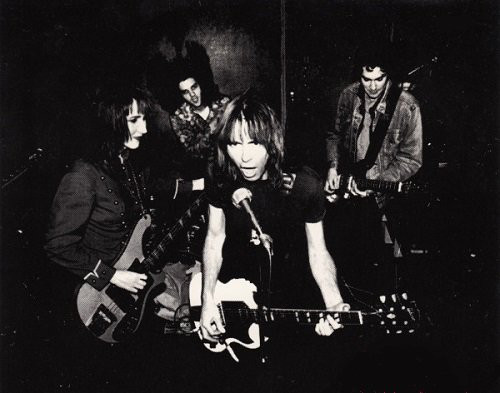
The Homosexuals


With a subversive name that didn't lend itself well to printed handbills, an art school D.I.Y. ethic, and a deconstructionist approach to music, cult '70s British punk rockers The Homosexuals were highly influential to those lucky enough to have heard them, but seemed doomed to obscurity from the beginning. Formed in South London from the ashes of The Rejects -who played at the Roxy alongside The Jam, The Damned, and Wire (probably the most direct comparison to The Homosexuals in terms of musical style)-vocalist Bruno McQuillan, guitarist Anton Hayman, and bassist Jim Welton adopted pseudonyms and changed their band name to The Homosexuals in 1978 as a move to break away from the punk scene and its limiting three-chord formula. After learning of the new name, previous Rejects' drummer Davey Dus departed. McQuillan picked up the slack, playing drums as well as continuing his role as a singer, and the trio started writing and rehearsing while squatting in Union Grove, Clapham Old Town. Apart from a few jam sessions at The Bull's Head, a local pub, most of their time over the next year was spent hopping from various studio sessions, with a rotation of a half-dozen drummers temporarily filling in from track to track. In 1979, McQuillan met and married conceptual artist Suzy Vida, who started collaborating with the group. She influenced them to incorporate performance art into upcoming live shows, appeared on some of their later tracks, and catalogued the majority of their output, which was becoming more and more difficult to locate -with the exception of 1984's 'The Homosexuals Record', pressed for vinyl on their own label Black Noise, the majority of their recorded material was comprised of EPs, bootlegs, and unreleased cassettes. By 1985, the band officially disbanded, shortly after Welton cited the rock-typical "creative differences" rationale as his reason for leaving. Various side projects ensued, including Sara Goes Pop, L. Voag, Amos & Sara, George Harassment, and Nancy Sesay & the Melodaires, but with only a limited number of copies available for collectors, it seemed that The Homosexuals themselves were all but a fading memory. Fortunately, in 2004, Bruno and Anton were united, and, with the help of Vida and Morphius Records, they compiled a complete 81-song overview of their output titled 'Astral Glamour'. [SOURCE: ALLMUSIC] 

miércoles, 24 de junio de 2020

The Honeymoon Killers


Guitarist Jerry Teel and bassist Lisa Wells founded The Honeymoon Killers in the summer of 1983. They were later accompanied by guitarist Michael O'Neill and former Ritual Tension bassist Claire Lawrence-Slater on their 1984 debut album 'The Honeymoon Killers from Mars', released on the band's own label Fur Records. Drummer Sally Edroso, who became the band's most consistent drummer, joined the band for the release of 'Love American Style' in 1985. Continuing as a trio the band released 1986's 'Let It Breed', which was recorded with Steve McAllister and composer/producer Mark Kramer. The following year Cristina Martinez, of Pussy Galore and Boss Hog, joined the band as a second guitarist for band's fourth album 'Turn Me On'. The EPs 'Take It Off!' and 'Til Death Do Us Part' followed in 1988 and 1990 respectively. 1991's 'Hung Far Low', the band's first studio album in four years, was recorded with drummer Russell Simins and guitarist Jon Spencer. The group disbanded in 1994, with its leader Jerry Teel joining The Chrome Cranks, founded by singer Peter Aaron and guitarist William Gilmore Weber in 1988, plus drummer Bob Bert. The double-disc retrospective anthology 'Sing Sing (1984-1994)' was released in 1997 by Sympathy for the Record Industry. [SOURCE: WIKIPEDIA] 

martes, 23 de junio de 2020

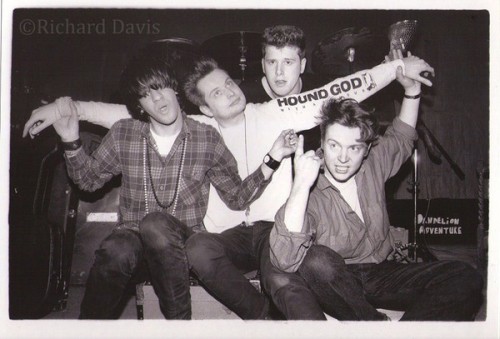
Hound God With A Tumour


Hound God With a Tumour was a short-lived noise rock / post-punk project from Manchester, United Kingdom. Formed by Harry Stafford after the breakup of his previous band, Inca Babies. [SOURCE: SPUTNIKMUSIC] 

lunes, 22 de junio de 2020

Hugo Race


An important and prolific figure on Australia's post-punk scene, Hugo Race has enjoyed a busy solo career while also working with some of the best-known and most respected names in the Antipodes. Hugo Justin Race was born in Melbourne, Australia on May 23, 1963. Hugo's first musical influences came from his family; his mother played piano, and his father was an avid music buff who favored classical music and musical theater. As the first wave of punk and new wave swept through Australia, Race was swept up, and he formed his first band in 1978, playing guitar and singing lead with the group Dum Dum Fit. In 1980, Race joined the regionally popular new wave-noise combo Plays with Marionettes, but he left the group in 1983 to join a new project from the lead singer of The Birthday Party. Originally known as Nick Cave: Man or Myth, the group was soon renamed Nick Cave & The Bad Seeds, and Race played on two of their albums, 1984's 'From Her to Eternity' and 1986's 'Kicking Against the Pricks'. 


In 1987, Race parted ways with Cave to form The Wreckery, a blues-influenced band featuring fellow Plays with Marionettes alumnus Edward Clayton-Jones. The Wreckery released three albums in their short history, 1987's 'Yeh My People' and 'Here at Pains Insistence' and 1988's 'Laying Down Law', before they split and Race stepped forward with his own band, Hugo Race & The True Spirit. Describing their music as "Trance Industrial Blues," Race & the True Spirit would release 13 albums between 1988 and 2015, making it Race's most prolific ensemble, though he also found time for other projects. Sepiatone was a collaboration between Race and Italian musician Marta Collica that resulted in three albums, beginning with 2001's 'In Sepiatone'. In 2001, Race teamed with the Italian ambient group Sacri Cuori to create Hugo Race & Fatalists, who released their first album, 'We Never Had Control', in 2011. With Chris Eckman of The Walkabouts, Race formed Dirtmusic, who issued four albums between 2007 and 2013. And in 2014, Race presented the live premiere of Long Distance Operators, a project featuring Belgian artist Catherine Graindorge; the duo released their self-titled debut album in early 2017. [SOURCE: ALLMUSIC] 

jueves, 18 de junio de 2020

The Frantic Elevators


Frantic Elevators were a punk band best known for being the jumping-off point for a pre-Simply Red Mick Hucknall. Formed in 1976 after the band met each other at a Sex Pistols gig, the group consisted of vocalist Mick Hucknall, drummer Kevin Williams, guitarist Neil Smith, and bassist Brian Turner. The band's first single, 'Voice in the Dark', was released in June of 1979 by TJM records. They hopped over to Eric's Records, the label affiliated with the Liverpool club of the same name, for the 'You Know What You Told Me' single, which was released near the end of 1980. A trio of radio sessions for the BBC followed in 1981, along with their third single, 'Searching for the Only One'. After that, an extended recording hiatus ensued, predating what would become their final single, 1982's 'Holding Back the Years' (No Waiting). Just less than four years later, Hucknall re-recorded the song with Simply Red, and it became an international smash. [SOURCE: JOHN PEEL WIKI] 

miércoles, 17 de junio de 2020

TV21


The new wave band TV21 formed in the late '70s, comprising drummer Colin Maclean, guitarist Ally Palmer, bassist Neil Baldwin, and vocalist/guitarist Norman Rodger. The band took their name from "Thunderbirds" creator Gerry Anderson's fanzine. After releasing their first two singles on Powerbeat in early 1980, they recorded a session for John Peel's BBC radio program. Another pair of singles followed for the Demon label in 1981. Maclean split and was replaced by Ali Patterson, a former member of The Rezillos. Deram snapped the group up and issued 'A Thin Red Line' in late 1981, the band's only long-player. Renowned producer and musician Ian Broudie (Original Mirrors, The Lightning Seeds), who had produced one of the group's earlier singles, loaned his skills to one of the songs on the record. Yet another single followed in early 1982, and the group's potential hit a peak when they opened a series of shows for The Rolling Stones as they toured Scotland. However, TV21 felt they had reached an impasse musically and opted to break up by the middle of the year. [SOURCE: ALLMUSIC] 

martes, 16 de junio de 2020

Helmet


Like many influential bands, Helmet were born out of an unusual set of influences. Oregon-born guitarist and founder Page Hamilton had actually moved to New York City to study jazz, but found inspiration in the late '80s through post-punk acts Sonic Youth, Killing Joke, and Big Black, and envisioned a group that combined then-unusual tunings (particularly dropped D) with uneven and jazz-like time signatures and harmonies. The result was Helmet, the East Coast's answer to Seattle's then-underground sensation Soundgarden. Hamilton recruited bassist Henry Bogdan from Oregon, along with Australian guitarist Peter Mengede and Florida drummer John Stanier for the group's first incarnation. Helmet's independent label debut EP, 'Strap It On', showcased the group's raw power -both instrumentally and in Hamilton's growling vocals- through tracks like the mocking "Sinatra" and rocking "Bad Mood." 

Signed to the Interscope label soon thereafter, the same lineup released its breakthrough 1992 CD, 'Meantime'. MTV aired three videos by Helmet, then the only band close to the Seattle grunge sound on the East Coast, in "Give It," "In the Meantime," and the distorted, stop-and-start showcase "Unsung." Hamilton, Bogdan, and Stanier collaborated with Irish rap group House of Pain on "Just Another Victim" for the 1993 film "Judgment Night", after Mengede left the band. The popular soundtrack (with its unorthodox mix of rappers and alternative bands like Ice-T and Slayer, Sir Mix-a-Lot and Mudhoney) created even more of a demand for Helmet's next CD. Replacing Mengede with guitarist Rob Echeverria on 1994's 'Betty', Hamilton crafted an album even more versatile -and at times even heavier- than 'Meantime'. The song "Milquetoast" appeared on the soundtrack to the hit film "The Crow"; Stanier's unrelenting drumming drove tracks like "I Know," and Hamilton's jazz background showed on the cover of Dizzy Gillespie's "Beautiful Love." Yet 'Betty' proved to be a critical success but a commercial failure, its versatility relegating it to the cutout bins. 


Echeverria left Helmet in the mid-'90s to join Biohazard, and the band bought time to refocus by releasing the 'Born Annoying' collection of B-sides in 1995. Hamilton played all the guitar parts for 1997's 'Aftertaste' -but his vocals sounded like his heart just wasn't in a group in which he couldn't keep a rhythm guitarist, and the album proved a disappointment. After touring with Orange 9mm's Chris Traynor on guitar and much deliberation, Helmet disbanded in 1999. But the Helmet influence was heard throughout rock, whether by Hamilton's involvement with industrial groups (Nine Inch Nails) or indirectly through metal acts (System of a Down), and even the atonal distortion of rap-rock hybrids such as Korn and Limp Bizkit. 

Helmet returned in 2004 when Hamilton recruited Traynor and a new rhythm section consisting of drummer John Tempesta (Rob Zombie, Testament) and bassist Frank Bello (Anthrax); signed to Interscope, the group released 'Size Matters' in October of that year. The lineup would change with following albums as well. Drummer Mike Jost and bassist Jeremy Chatelain joined Hamilton and Traynor for 2006’s 'Monochrome', released on Warcon/Fontana, and guitarist Dan Beeman and drummer Kyle Stevenson rotated in for 2010’s 'Seeing Eye Dog'. 

After a six-year silence, Helmet reemerged in late 2016 with their eighth album, 'Dead to the World' (earMusic). Produced by Hamilton, it was the first release to feature new bassist Dave Case. [SOURCE: ALLMUSIC] 

lunes, 15 de junio de 2020

Elliott Sharp


A major figure in New York City's avant-garde music community since the '70s, Elliott Sharp is a composer and instrumentalist whose body of work runs the gamut from experimental and contemporary classical pieces to blues, noise rock, and electronic music. 

Sharp was born in Cleveland, Ohio on March 1, 1951, and displayed a talent for music at an early age. He insists he began learning the piano when he was six years old, and started performing in public when he was eight. Sharp then took up the clarinet, and later the guitar. Sharp was also passionately interested in science and electronics, and after turning his attention to the electric guitar, he began designing and building his own effects boxes. A self-described "science geek," Sharp studied at Carnegie Mellon University while still in high school under a grant from the National Science Foundation, and his music has been informed by such disparate disciplines as chaos theory, Fibonacci sequences, fractal geometry, algorithms, and genetic metaphors. In 1969, Sharp entered Cornell University, where his studies focused on anthropology, music, and electronics. Sharp later transferred to Bard College, where he studied improvisation and ethnomusicology with noted free jazz artist Roswell Rudd, and composition with Benjamin Boretz. (Sharp's classmates at Bard included brothers John Lurie and Evan Lurie, who would go one to form the "fake jazz" ensemble The Lounge Lizards.) After getting his B.A. at Bard, Sharp did graduate work at the University of Buffalo, where he studied with Morton Feldman and Lejaren Hiller. Sharp completed his studies in 1977, and in 1979 he settled in New York City, where he launched a career in which he has produced a prolific and diverse variety of work. 


Sharp released his first album in 1977, a collaboration with David Fulton called 'Hara', and between then and 2014, he issued over 85 albums, either as a solo artist or with his many collaborative projects, including Carbon, Semantics, Terraplane, and Bootstrappers. Sharp's collaborations have seen him work with an impressive range of artists, including The Kronos Quartet, pop singer Debbie Harry, iconic qawwali vocalist Nusrat Fateh Ali Khan, blues legend Hubert Sumlin, turntable artist Christian Marclay, influential jazz guitarist Sonny Sharrock, and contemporary art music group Ensemble Modern. In addition to composing for various instruments and performing on guitar and clarinet, Sharp was an early advocate of electronic music; in the '80s, he began performing on-stage with computers in his 'Virtual Stance' project, and in addition to recording several techno pieces, he regularly performs under the moniker Tectonics, in which he combines eight-string bass with material and manipulations from his laptop. He also released the 2019 effort 'Syzygy', in which he combined pre-programed sounds with electronic and acoustic instruments, including the theremin. 

In addition, Sharp has composed and performed scores for a number of documentaries and independent films, including "Speaking for Myself" (2010), "Commune" (2005), "What Sebastian Dreamt" (2004), and "Daddy and the Muscle Academy" (1991). (He was also the subject of a 2008 documentary, "Elliott Sharp: Doin' the Don't"). Sharp has created sound designs for interstitial "bumpers" used on MTV, the Sundance Channel, and Bravo. And Sharp was the recipient of a Guggenheim Fellowship in 2014, as well as another from the Parson's Center for Transformative Media that same year. [SOURCE: ALLMUSIC]